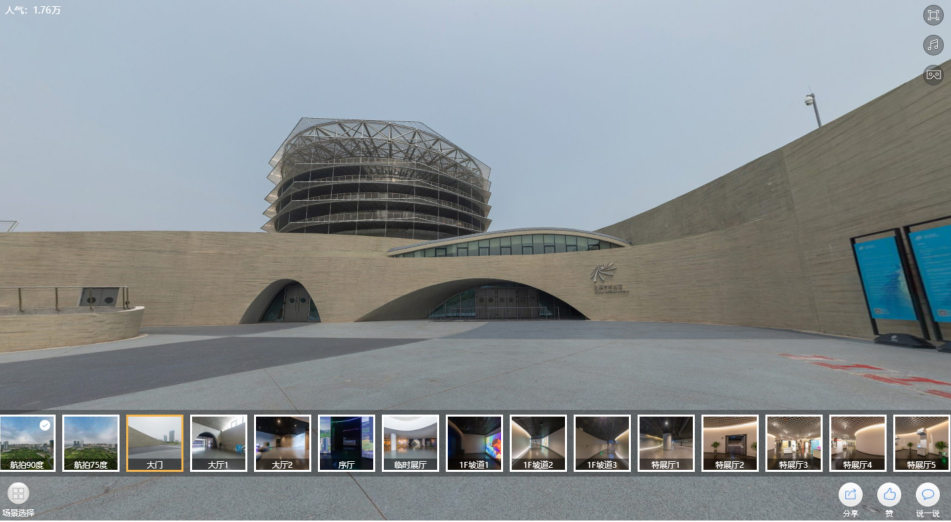
With the three-dimensional and immersive experience enabled by 720-degree panoramic production technology, online museums can also deliver the authenticity, interactivity, and enjoyment of visiting a physical exhibition hall. The exhibition hall can showcase its features through pop-up displays, greatly promoting its publicity.
The 720° museum brings people a brand-new sense of real presence, combining visual effects, background narration, Flash, video and other multimedia elements to achieve a truly interactive effect, allowing users to conveniently view the 3D panorama from multiple angles interactively. The 3D panorama display can be used on web platforms, as well as on multimedia touch screens, large-screen full-screen projections, tablet and mobile devices, and 360 panorama display systems; it can also be produced in CD format to promote digital exhibition halls.
The 720 panoramic shooting customization solution supports customers to freely visit every door, display board, and corner of the exhibition hall at 720 degrees, rotate the angle at will, and stroll in a relaxed and pleasant background music, scene by scene, find the exhibits they are interested in or need to understand, and then click on multimedia content such as audio and video, 3D animation, etc., to understand rich and comprehensive product and exhibition hall content. They can also participate in comments and messages, enjoying lively social interaction like on-site.
With the three-dimensional sense and immersion of 720 panoramic production technology, online museums can also have the real, interactive, and pleasant experience of visiting exhibition halls offline. The exhibition hall can display its characteristics through pop-up windows, greatly promoting the exhibition hall's publicity.
720° 3D Simulation Scanning and Production of Cultural Relics
For a single object, based on its shape and surface complexity, multiple angles are selected for non-contact acquisition. The acquired data includes: object form, structure, texture, material, color, and mapping. Ultra-high-definition cameras are used for static photography of precious cultural relics, rare ancient books, and artworks, and through post-production image stitching technology, the final generation of ultra-high-precision images is completed.



 Consultation Phone:
400 807 2882
Consultation Phone:
400 807 2882