
Digital wireless audio · connecting smart spaces
Language / Select Language
Home
About Us
Product Showcase
News
Engineering Cases
Service Support
Solutions
Talent Recruitment
SOYO Mall
Contact Us
Leave a message

Analysis of the trend of digitalization in global museums under the new normal of the pandemic
Summary : The digitalization of museums has become the new normal in the post-pandemic era.
2022-08-03
I. Museum digitalization has become the new normal in the post-pandemic era
1.The demand for museum digitalization has intensified
"13th Five-Year Plan" period, on average, a new museum was added every two days in China, and there was one museum for every 250,000 people. By the end of 2021, the total number of registered museums nationwide had reached 6,183. In 2020, the COVID-19 pandemic broke out and spread globally, making contactless and smart services a basic attribute of economic life, cultural education, and social management. As a result, museum communication and services increasingly shifted online. Against the backdrop of the pandemic in 2020, museums were generally closed for long periods, yet China still launched over 29,000 exhibitions, held over 225,000 educational activities, received 540 million visitors, and attracted hundreds of millions of online viewers.
From 2020 to 2021, the International Council of Museums(The International Council ofMuseums, abbreviated asICOM) conducted3 global surveys on museums and the COVID-19 pandemic. The reports presented the international landscape and basic trends of museum digital activities in the past two years.
In March 2020, the "Survey Report on Museums, Museum Professionals and the COVID-19 Pandemic" released by ICOM showed that 85,000 museums worldwide were forced to close due to the pandemic, of which approximately13% might never reopen. The American Alliance of Museums released in July 2020 the "National Survey on the Impact ofCOVID-19 on U.S. Museums", which disclosed that due to financial problems related to the pandemic, one-third of cultural and museum institutions across the United States might permanently close.
2.International Trends in the Application of Digital Technology in Museums
2021 year 5 month ICOM's third survey data showed that museums began to explore the application of digital technology under the "new normal" in the pandemic, and museums have gradually established different digital communication channels.
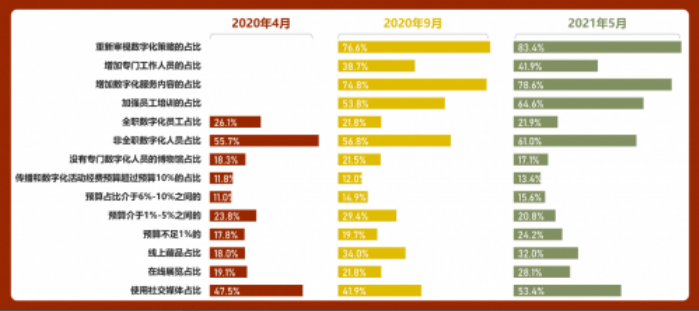
First, regarding the adjustments in museum digitalization strategies. Among the surveyed museums, from September 2020 to May 2021, the changes were: "Re-examining digital strategies" increased from 76.6% to 83.4%; "Adding dedicated staff" increased from 38.7% to 41.9%; "Increasing digital budgets" increased from 43.2% to 52.1%; "Expanding digital service content" increased from 74.8% to 78.6%; "Strengthening staff training" increased from 53.8% to 64.6%. Second, from the perspective of human resource investment in museum digital activities. Among those with full-time digital staff, the proportions in April 2020, September, and May 2021 were 26.1%, 21.8%, and 21.9%, respectively; among those with part-time digital staff, the proportions at these three time points were 55.7%, 56.8%, and 61.0%, respectively, with a gradual increase within less than a year; among those without dedicated digital staff, the proportions at the three time points were 18.3%, 21.5%, and 17.1%, respectively. The data shows a trend: the proportion of employees engaged in part-time digital work is increasing, indicating that the allocation of museum human resources is shifting toward communication and digital activities, while the proportion of museums without any dedicated digital staff has decreased. Third, from the perspective of the proportion of communication and digitalization activities in the total museum budget. Among the surveyed museums, those with budgets for communication and digitalization activities exceeding 10% of the total budget accounted for 11.8% in April 2020, 12.0% in September 2020, and 13.4% in May 2021; those between 6%-10% accounted for 11.0%, 14.9%, and 15.6% at the three time points, respectively; those between 1%-5% accounted for 23.8%, 29.4%, and 20.8% at the three time points, respectively; those with less than 1% accounted for 17.8%, 19.7%, and 24.2% at the three time points, respectively. It can be seen that, despite the deteriorating financial situation, the proportion of museum budgets planned for digital and communication activities increased by 6.2%.
Fourth, from the perspective of various online activities of museums. Among the surveyed museums, various online activities have increased compared to before the pandemic. By activity type: In April 2020, September 2020, and May 2021, the proportions of online collections were 18.0%, 34%, and 32% respectively; online exhibitions were 16.4%, 16.1%, and 22.0% respectively; live streaming of events accounted for 19.1%, 21.8%, and 28.1% respectively; use of social media accounted for 47.5%, 41.9%, and 53.4% respectively. In May 2021, among museums that started online activities after closing, the proportions of online collections, online exhibitions, live streaming of events, and use of social media were 9.7%, 17.4%, 26.5%, and 3.8% respectively.
Figure ICOM Key data from the global museum survey conducted by ICOM from April 2020 to May 2021.
II. The Necessity of Digital Construction from the Dual Perspectives of Museums and Audiences
From the perspective of museums serving audiences, emerging technological means can digitize precious cultural relics, accurately restore them to virtual or real scenes through digital devices, and also enable real-time interaction for various groups both online and offline.
The application of digital technologies such as in China's museum sector can be traced back to the late 20th century 90s. For example, the Henan Museum and the Shanghai Museum, in addition to establishing their official websites, were among the first to attempt digital processing of their collections, allowing visitors to browse collection information and flat images of the collections online.
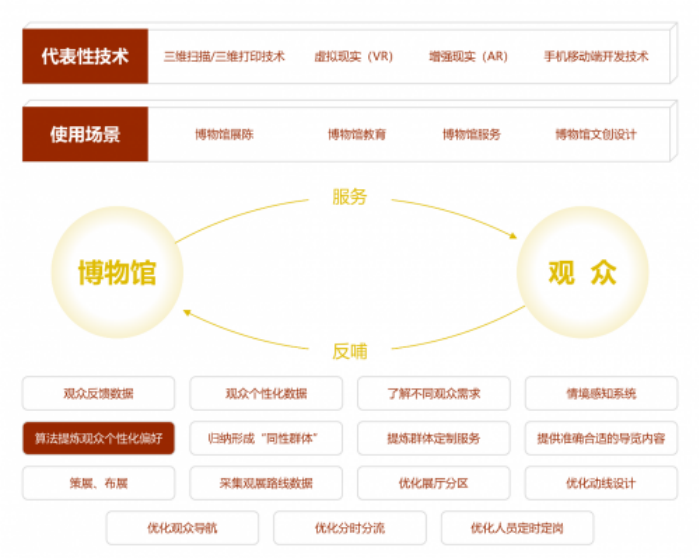
After entering the 21st century, museum digital technology gradually shifted from a single online product to a combination of online and offline products. Specific usage scenarios include museum exhibitions, museum education, museum services, and museum cultural and creative design. Representative technologies include 3D scanning /3D printing, virtual reality (VR)/augmented reality (AR) technology, and mobile client development technology.
From the perspective of the audience giving back to the museum, museum digital technology provides a large amount of audience feedback data and personalized information of visitors, thereby giving the museum the opportunity to customize personalized guided tour services for the audience. In the context of big data, the museum can understand the needs of different visitors, and through the "context-aware system", analyze and extract the personalized preferences of visitors through backend algorithms, and once summarized to form "homogeneous" groups, thereby providing group customized services and more accurate and appropriate guided tour content.
This method can be applied to the curation and layout of museum exhibitions. It can combine the positioning function of visitors' handheld devices to collect information such as visitors' tour routes and the time they stay in front of each display case, thereby helping to optimize the zoning of museum exhibition halls, the design of visitor flow lines, visitor navigation, time-based and flow-based diversion, and the fixed-time and fixed-post arrangement of museum staff, providing first-hand data to help the museum make real-time adjustments and plan improvements, and better provide customized services to visitors.
Figure 2 Schematic diagram of digital construction from the two-way perspective of museum and audience
Third, China attaches great importance to the digitalization of museums
One of the core contents of the important series of expositions on cultural relics work is to make cultural relics"live"up. And making cultural relics"live"up naturally cannot be separated from the digitalization of cultural relics and the digitalization of museums.
The "Internet+Chinese Civilization"Three-Year Action Plan, jointly issued by the National Cultural Heritage Administration and the National Development and Reform Commission and other departments in2016, proposed encouraging the digital display and utilization of cultural relics and encouraging qualified cultural relics and museums to carry out smart museum work.
The "Outline of the 14th Five-Year Plan for National Economic and Social Development and the Long-Range Objectives Through the Year 2035" of the People's Republic of China, released in March 2021, mentioned "museum digitalization" twice. In May 2021, the National Cultural Heritage Administration and eight other central departments jointly issued the "Guiding Opinions on Promoting the Reform and Development of Museums" (hereinafter referred to as the "Opinions"), which proposed the strategic goal of basically building China into a world museum power by 2035. The Opinions contain many statements on the construction of smart museums, clearly pointing out the need to "vigorously develop smart museums, with business needs as the core and modern science and technology as support, and gradually realize smart services, smart protection, and smart management."In November 2021, the "14th Five-Year" Plan for Cultural Relics Protection and Scientific and Technological Innovation was officially issued. This is the first time that scientific and technological innovation has been included in the title, and a "full-chain" layout has been made for enhancing the innovation capability of cultural relics science and technology. The text respectively mentions the need to "accelerate the digitization of museum collections" and "promote the development of online digital experience products in museums, providing new cultural tourism services such as immersive experiences, virtual exhibition halls, and high-definition live streaming".
Figure 3 Word cloud of the "14th Five-Year" Plan for Cultural Relics Protection and Scientific and Technological Innovation

In May 2022, the "Opinions on Promoting the Implementation of the National Cultural Digitization Strategy" issued by the General Office of the CPC Central Committee and the General Office of the State Council clarified that by the end of the "14th Five-Year Plan" period, the cultural digitization infrastructure and service platform will be basically completed, forming a cultural service supply system with online-offline interactive integration and three-dimensional coverage. By 2035, a national cultural big data system with physical distribution, logical correlation, fast linking, efficient search, comprehensive sharing, and key integration will be built, presenting the full panorama of Chinese culture and sharing the achievements of Chinese cultural digitization with all the people. The value and role of museum digitization construction in the national cultural digitization strategy should not be underestimated.